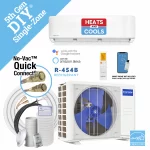
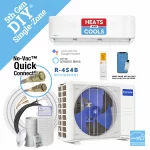
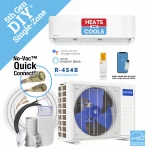
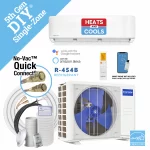
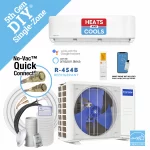

If you are looking at a ductless system for a garage, sunroom, shop, bonus room, or even a full home upgrade, a diy mini split review needs to answer one thing first – is it actually worth installing yourself in South Texas heat? For many homeowners, the answer is yes, but only when the equipment is sized correctly, the install is done carefully, and there is real support behind the product if something goes wrong.
That is where a lot of online reviews miss the mark. They tend to focus on the thrill of getting a system delivered to the house and mounted on the wall. What matters more is how the unit performs in July, how efficiently it runs when humidity stays high, and whether you can still get service after the box is opened.
DIY mini split review: what matters most
A DIY mini split can be a smart buy because it lowers installation costs and opens up comfort options in spaces where extending ductwork does not make financial sense. Homeowners often choose these systems for detached garages, home offices, additions, workshops, and older homes with limited duct access. In those situations, a ductless setup is often cleaner, faster, and more energy-efficient than forcing a traditional central system to do a job it was never designed to do.
The biggest advantage is cost control. A true DIY-ready system can reduce labor expense, especially when the line set comes pre-charged and the installation process is designed for capable homeowners. That makes the upfront price more manageable for people who want better comfort without taking on a full remodel.
Still, a good diy mini split review should not treat every homeowner the same. Some customers are comfortable handling mounting, electrical planning, condensate routing, and wall penetrations. Others are better off buying the same equipment and pairing it with licensed installation. The right choice depends on your tools, your time, and your confidence level.
Where DIY mini splits perform well
In South Texas, mini splits make a lot of sense because they offer targeted cooling and efficient operation in spaces that are hard to regulate with central air. A garage gym, a backyard office, or a converted room can all benefit from a dedicated system that does not overwork the rest of the house.
They also work well for homeowners trying to solve hot and cold spots. If one bedroom stays warmer than the others or a room addition never quite catches up, a ductless system can fix the comfort issue without major duct modifications.
For many buyers, the appeal is not just flexibility. It is also control. Mini splits let you cool the space you are using instead of conditioning square footage that sits empty most of the day. That can help with utility costs, especially when the equipment is inverter-driven and built for efficient operation.
The real pros in a DIY mini split review
The strongest point in favor of DIY systems is convenience. The equipment is designed to simplify installation compared with traditional HVAC products, and that matters for homeowners who want a practical path to better comfort. You can often avoid the complexity of brazing refrigerant lines, scheduling a full installation crew, or waiting through a long backlog during peak cooling season.
Another major benefit is product access. Homeowners can choose the capacity and configuration they need without being limited to whatever a big-box store happens to stock that week. When you buy from an authorized dealer, you also get better guidance on sizing, compatibility, accessories, and warranty expectations.
Then there is the issue of support. This is one of the biggest differences between a smart DIY purchase and a risky one. Some HVAC contractors will not touch DIY equipment once it has been installed, even if the problem is minor. That leaves homeowners stuck. Buying from a dealer that understands the product and is willing to support DIY systems changes the equation in a meaningful way.
The trade-offs most reviews skip
DIY does not mean effortless. It means homeowner-installable under the right conditions. That distinction matters.
A mini split still needs proper sizing. Too small, and it will struggle during extreme heat. Too large, and it may short cycle, affecting comfort and humidity control. In Corpus Christi and across South Texas, humidity is not a side issue. It is part of the comfort load. That is why room size alone is not enough when choosing capacity.
Electrical requirements are another area where buyers need to be realistic. Even when the refrigerant side is simplified, the unit still needs correct power supply, breaker sizing, and code-compliant connections. Some homeowners can handle part of the install but still need an electrician or HVAC professional to finish the job correctly.
Installation quality also affects long-term performance. A poorly mounted air handler, bad condensate drainage, or careless line routing can create problems that have nothing to do with the equipment itself. When a customer says a mini split “didn’t work out,” sometimes the issue is really installation, not product quality.
DIY mini split review: MRCOOL and buyer confidence
Among DIY mini split options, MRCOOL stands out because the brand was built with the homeowner-install market in mind. That matters because not every ductless system labeled as simple is truly set up for DIY use. Pre-charged line sets, clearer installation design, and broad product availability make MRCOOL a strong fit for customers who want control over the project without gambling on an unknown brand.
Just as important, the systems are familiar to dealers and service professionals who already work with the brand. That creates more confidence before and after the sale. For homeowners in South Texas, that support matters as much as SEER ratings and feature lists.
This is where Your Bargain Mart brings real value. As a local authorized MRCOOL dealer serving Corpus Christi, the company helps customers choose the right system, understand their options, and get support for both DIY and professionally installed units. That local accountability is a major advantage over ordering equipment from a national seller that disappears after delivery.
Who should buy a DIY mini split
A DIY mini split is a strong option for homeowners who are comfortable with home improvement projects, want to save on labor, and understand that planning matters as much as the equipment. It is especially attractive for straightforward single-zone applications where the layout is simple and the goal is to cool or heat one dedicated area.
It is also a good fit for buyers who want flexibility. Some customers install the full system themselves. Others handle the basic site prep and mounting, then bring in licensed help for final electrical or startup-related tasks where needed. That hybrid approach can still save money while reducing the risk of mistakes.
On the other hand, if your home has complex load requirements, multiple rooms, difficult line routing, or code-related concerns, professional installation may be the better investment. Paying for expert setup can be cheaper than correcting a failed install later.
What to check before you buy
Before purchasing, make sure you have a clear answer on sizing, electrical requirements, indoor and outdoor unit placement, and drainage. Think about how the room is used, how much direct sun it gets, how well it is insulated, and whether the space stays closed off or opens to adjoining areas.
You should also ask what kind of support is available after purchase. Can someone help if you need troubleshooting? Will the warranty be straightforward? Is there local service available if your DIY project turns into a repair call later? Those questions are not extras. They are part of the value.
Price matters, but the cheapest unit is not always the best deal. A system with factory-backed warranty support, legitimate dealer guidance, and local service access often delivers more value than a lower-priced product with no safety net behind it.
Final take on this DIY mini split review
For the right homeowner, a DIY mini split is not a gimmick. It is a practical way to add efficient heating and cooling without the full cost of a traditional install. The key is buying the right equipment, sizing it correctly, and making sure support does not end at checkout.
If you want the savings of DIY without the usual uncertainty, the best move is to buy from a local source that understands the equipment, stands behind the product, and can still help after the install. That is what turns a good purchase into a dependable comfort upgrade.