
- What the evaporator coil actually does
- When to replace evaporator coil instead of repairing it
- Signs your evaporator coil may be failing
- When to Replace Evaporator Coil Components Before Bigger Problems Start
- Repair or replace depends on the refrigerant, too
- When replacing just the coil makes sense
- When full system replacement is the smarter investment
- South Texas conditions can shorten coil life
- How to decide without overspending
- The bottom line for homeowners
Many homeowners aren’t sure when to replace evaporator coil components because early symptoms can look like simple maintenance issues. Knowing the warning signs helps prevent bigger failures and wasted repair costs.
I’ll be straight with you — If your AC is running longer, cooling less, or freezing up when South Texas heat is doing its worst, you may be wondering when to replace evaporator coil components instead of paying for another repair. That’s a fair question, especially when the system still turns on and seems like it should have more life left. The problem is that a failing coil often gets expensive before it becomes obvious.
A small confession: For homeowners in Corpus Christi and nearby areas, this decision usually comes down to three things: age, condition, and cost. An evaporator coil isn’t a cosmetic part. It’s one of the core pieces that lets your air conditioner or heat pump remove heat from the air inside your home. When it starts leaking, corroding, or losing performance, comfort drops fast, and utility bills can climb with it.
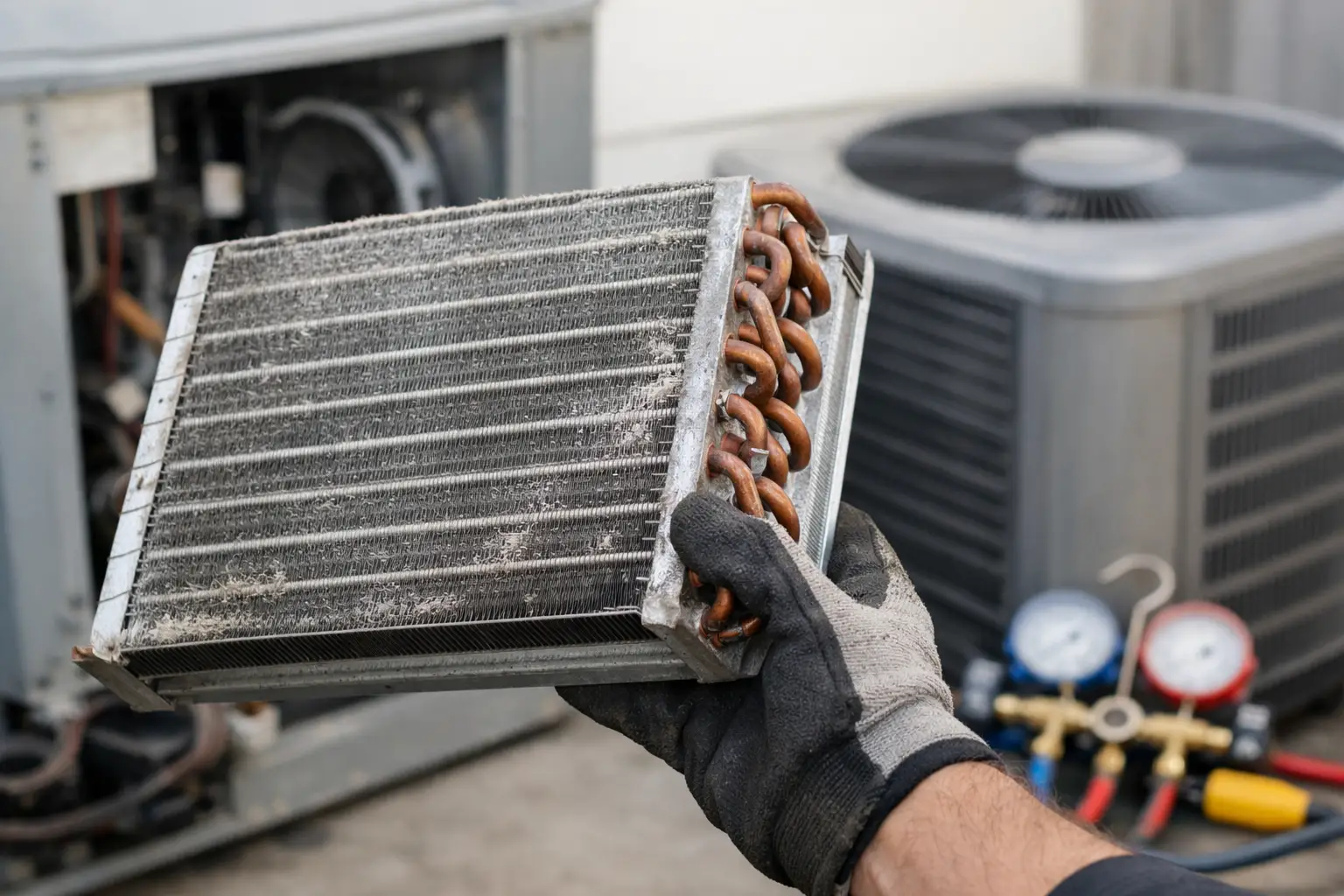
What the evaporator coil actually does
The evaporator coil sits inside the indoor part of your HVAC system, usually near the air handler or furnace. Refrigerant passes through the coil and absorbs heat from the indoor air. That’s how your system cools the home and helps manage humidity.
When the coil is in good shape, airflow stays consistent, temperatures stay more even, and the system doesn’t have to work harder than it should. When the coil starts failing, you may notice weak cooling, warm spots, ice buildup, or a system that seems to run all day without catching up.
When to replace evaporator coil instead of repairing it
There’s no single rule that fits every system, but there are some clear situations where replacement is usually the smarter move.
The coil has a refrigerant leak
A leaking evaporator coil is one of the most common reasons for replacement. Small leaks can sometimes be repaired, but that doesn’t always provide the best value. If the coil has multiple leak points or signs of widespread corrosion, patching one area may only buy a little time.
This matters even more if you’ve already added refrigerant once or twice. Refrigerant doesn’t get used up under normal operation. If levels are low, there’s a leak somewhere. Recharging the system without solving the root problem is a temporary fix, not a solution.
The coil keeps freezing over
Frozen coils can happen for a few reasons, including dirty filters, airflow restrictions, and low refrigerant. If basic maintenance issues have already been ruled out and the coil continues freezing, replacement may be necessary. Repeated icing often points to deeper coil or refrigerant circuit problems that won’t go away on their own.
The system is 10 years old or more
Age by itself doesn’t guarantee failure, but it should influence your decision. If the evaporator coil is failing in a system that’s already 10 to 15 years old, putting money into a major repair may not make sense. You could replace the coil and still face compressor issues, blower problems, or declining efficiency not long after.
In many cases, the older the system, the more important it becomes to look at the whole setup instead of just the failed part.
The repair cost is too close to the replacement value
A common rule of thumb is simple: if the repair is a large percentage of the system’s remaining value, replacement deserves a serious look. An evaporator coil isn’t a minor part. Labor, refrigerant handling, compatibility concerns, and warranty limitations can make the total repair bill significant.
If you’re spending a major amount on an older system with uncertain future reliability, replacement often gives you a better return.
Signs your evaporator coil may be failing
Some symptoms are subtle at first. Others show up all at once during the hottest part of the year.
Warm air from the vents is one warning sign, especially if the thermostat is set correctly and the outdoor unit is running. Another is poor humidity control. In Corpus Christi, that matters because comfort isn’t just about temperature. If your house feels sticky even when the AC is on, the coil may not be doing its job well.
You might also hear hissing from a refrigerant leak, notice water around the indoor unit from ice melting, or see your electric bill rising without a clear reason. Short cycling and longer run times can show up, too. None of these signs proves the coil is the problem by itself, but together they build a strong case for inspection.
If you’re noticing repeated icing, weak airflow, or warm air, these are strong indicators of when to replace evaporator coil parts before the system loses cooling completely.
When to Replace Evaporator Coil Components Before Bigger Problems Start
Many homeowners wait until the system stops cooling completely, but knowing when to replace evaporator coil parts earlier can prevent expensive breakdowns. If you’re seeing warm air, poor humidity control, or repeated icing even after basic maintenance, the coil may already be past the point where repairs make sense. Replacing the coil before peak summer heat can restore performance and prevent the system from running nonstop just to keep up.
Repair or replace depends on the refrigerant, too
This is where the decision gets more technical. Older systems may use refrigerants that are harder to source and more expensive than they used to be. If your evaporator coil fails in one of those systems, replacement can get costly fast, and sometimes coil availability becomes part of the problem.
There’s also the issue of compatibility. A new coil must match the system properly. Mismatched components can reduce efficiency, shorten equipment life, and create performance issues. That’s one reason homeowners should be cautious about quick, low-price fixes that don’t address system matching.
When replacing just the coil makes sense
Sometimes coil replacement is absolutely the right call. If the outdoor unit is still in good condition, the system is relatively new, parts are available, and the repair restores reliable performance at a reasonable cost, replacing only the evaporator coil can be a practical choice.
This tends to make the most sense when the rest of the system has years of expected life left and the repair doesn’t force you into repeated service calls. For homeowners trying to protect their budget without cutting corners, that can be a solid middle ground.
When full system replacement is the smarter investment
If the coil is failing in an aging system, full replacement is often the better long-term move. That’s especially true if you’ve had recurring refrigerant issues, rising repair bills, or uneven comfort throughout the house. Replacing just the coil can feel cheaper today while costing more over the next few years.
A newer matched system can improve efficiency, humidity control, and reliability. For some homes, it also opens up better equipment options, including heat pumps, central systems, or ductless solutions for additions, garages, or problem rooms.
For customers who want straightforward guidance, this is where working with a local dealer matters. Your Bargain Mart helps homeowners compare repair versus replacement with honest pricing, factory-backed warranty options, and local service support that many big-box sellers simply don’t provide.
Not sure if the symptoms you’re seeing mean it’s time to replace the coil? If you’re dealing with warm air, repeated icing, or rising energy bills, it may be the moment to figure out when to replace evaporator coil components before the system fails. Get a fast, honest diagnosis from Your Bargain Mart — no pressure, no upsells, just clear answers so you can make the right call.
South Texas conditions can shorten coil life
Evaporator coils don’t fail on a schedule, but climate plays a role. In South Texas, long cooling seasons, heavy humidity, and salt-influenced coastal air can all put added strain on HVAC equipment. A system that runs hard for much of the year will show wear faster than one in a milder climate.
That doesn’t mean every coil near the coast is headed for early failure. It does mean regular maintenance matters more. Clean filters, proper airflow, and routine inspections can help catch coil problems before they turn into major breakdowns in the middle of summer.
Understanding when to replace evaporator coil components versus repairing them can save you hundreds in long‑term operating costs. A failing coil often forces the system to run longer, driving up energy bills.
How to decide without overspending
If you’re trying to decide when to replace evaporator coil parts, start with a clear diagnosis, not a guess. Ask how severe the leak or damage is, whether the repair is expected to last, how old the full system is, and whether the components are still a good match.
You should also ask for the practical numbers. What does the coil repair cost today? How much more would a full replacement be? What warranty protection applies in each case? The right answer isn’t always the cheapest line item. It’s the option that gives you dependable cooling without setting you up for another expensive problem soon after.
A trustworthy HVAC professional should be able to explain the trade-offs in plain language. If someone only pushes replacement without discussing repair, or only offers repair without talking about system age and refrigerant type, you’re probably not getting the full picture.
The bottom line for homeowners
An evaporator coil should usually be replaced when it’s leaking, repeatedly freezing, badly corroded, or too expensive to repair relative to the age and condition of the rest of the system. If the system is newer and otherwise sound, replacing the coil can be a smart fix. If the equipment is older and already showing its age, stepping back and considering full system replacement is often the more honest answer.
The best time to deal with a weak coil is before it turns a hot afternoon into an emergency call. A careful inspection and a straight answer now can save you money, stress, and a lot of uncomfortable nights later.
If you’re still unsure when to replace evaporator coil parts, a quick inspection can confirm whether the coil is leaking, corroded, or past its service life.
If you’re unsure when to replace evaporator coil components or whether a repair still makes sense, we can give you a clear, honest evaluation. Your Bargain Mart provides straightforward guidance, proper diagnostics, and reliable service so you don’t waste money on temporary fixes. Call (361) 271‑3513 today to schedule your inspection and find out exactly when to replace your evaporator coil for the best long‑term results.
u003cstrongu003eHow do I know when to replace evaporator coil parts instead of repairing them?u003c/strongu003e
Most homeowners decide u003cstrongu003ewhen to replace evaporator coilu003c/strongu003e components based on age, leaks, and repair cost. If the coil is leaking refrigerant, repeatedly freezing, or showing corrosion, replacement is usually the more reliable long‑term fix.
u003cstrongu003eIs it worth repairing an evaporator coil on an older system?u003c/strongu003e
If your system is 10–15 years old, repairing the coil may not be the best investment. In many cases, u003cstrongu003ewhen to replace evaporator coilu003c/strongu003e parts depends on whether the rest of the system still has enough life left to justify the repair.
u003cstrongu003eCan a failing evaporator coil cause higher energy bills?u003c/strongu003e
Yes. A weak or leaking coil forces the system to run longer and harder. If you’re trying to decide u003cstrongu003ewhen to replace evaporator coilu003c/strongu003e components, rising utility bills are a strong warning sign.
Related:
Furnace and AC Replacement: When It Makes Sense
How MRCOOL Products Improve Indoor Air Quality
Sources:
U.S. Department of Energy – Air Conditioner Basics (Coils, Efficiency, and Performance)